Viewing entries in
Theology

1 Comment

Walt Disney & Steve Jobs on Family

Photo Walt Disney and Steve Jobs; two men who have had an incredible impact on history we know it.  Stories that have touched our lives; life-long memories from family vacations.  Technological advancements that have changed the way that we consume media.  Both Steve Jobs and Walt Disney brilliantly led organizations that have had enormous impact on the world around them.  But in the midst of this impact there is an interesting difference in respects to these two men and their families.

According to the book Steve Jobs by Walter Isaacson regarding why he wanted a biography to be written:

"I wanted my kids to know me," [Steve Jobs] said.  "I wasn't always there for them, and I wanted them to know why and to understand what I did."

On our trip to Walt Disney World this week, we visited a showing of One Man's Dream in Hollywood Studios.  During the movie the narrator spoke of Walt's relationship with his daughters, noting that he had a weekly daddy-daughter day.  It was during one of those daddy-daughter days, as Walt watched his daughters play, that he noticed that the amusement parks were ragged, filthy, and not fun for parents.  Walt envisioned a new type of amusement park that families, like him and his daughters, could enjoy together.

Whose World Do You Want to Change?

Both men changed the world.  But at what expense?  If putting a dent in the universe means sacrificing your own family, is that worth the sacrifice?  In Steve Jobs on words, "Deciding what not to do is as important as deciding what to do."  What do you want to do and what are you going to stop doing in order to do it?  Maybe you change the world, first, by starting with your own home.  What if you pastored your family well and then worried about pastoring your church?  What if running your family organization was more important than starting a profitable business?

"A man should never neglect his family for business." - Walt Disney

I dream to have an impact on the world around me.  But more importantly I hope to lead my family well.

1 Comment

5 Comments

3 Solas

3Solas In order to seriously talk about any theology, we need to make clear what presuppositions we are bringing with us into the discussion.  We can talk for hours about the doctrine of the Trinity, but if I believe that the Bible is God's word and you do not, we need to talk about something other than the doctrine of the Trinity.  Since I often use this blog for theological musings, I think it's helpful for me to make clear three presuppositions that I have as I talk about the Bible.

Grace Alone

We are saved by grace.  Grace is central to what it means to be a Christian, and this will be foundational to everything in our theology.  If we are saved by grace alone, this heavily influences what we believe about God's activity towards man and man's response to God.  The belief that man has any role in his own salvation is dangerous; it is only because of God's grace that we have salvation.

Faith Alone

Christ died for all people, but not all people are saved.  Why?  God's death and ressurection was for all people, but the way that this has been applied to us as individuals is by faith alone.  We are saved by grace through faith.  There are no lists of 7 principles that will lead us to the gift of faith; faith simply comes from God.  And it is only through faith in Christ that we receive the benefit of forgiveness.

Scripture Alone

The place that our theology comes from, is always from scripture.  Our theology shouldn't come from popular opinion or scientific theories, but from the Word of God.  The scripture is the authority for any discussions on what we believe; if we are going to make claims about what we believe about things like God, the work of Christ, the creation of the world, or homosexuality, it is going to be based on the authority of scripture.  The scripture shapes our theology and is the reason that we are able to have any knowledge of our sin and God's grace.

What presuppositions do you have when talking about theology?

5 Comments

1 Comment

Theology Matters

You are a theologian.

You may not think of yourself as one, but the truth is you are one.  Theology is the study of God; since you are bound to have some opinions, beliefs, or practices related to who God is and what he has done, you are a theologian.  Good theology can give a person peace in a time of tragedy, hope when things seem hopeless, and grace when a person should feel guilt.  On the other hand, poor theology is toxic for the soul, leading individuals down paths that are dangerous both spiritually and also practically.

In our ministries it is important that we continually evaluate our theology.  What does the scripture say about what we are teaching?  What does God's word reveal to us about the things that we say are important?  How does our orthodoxy influence our daily practices?  The danger is that it is easy to fall into the trap of spending more time concerned with what is relevant at the expensive of worrying about what is true.  Relevance is critical, especially in youth ministry, but the truth is always relevant.

Theology matters.  Concern yourself with handling God's word properly.  Try to find the most effective way to teach your students God's word, but don't let the context take priority over the content of the message.

"Let your wife worry about your clothes.  Buy books and study.  We don't need any more well-dressed, hip, funny, heretics.  Who cares how you say it if what you're saying is wrong." - Matt Chandler, Pastor at The Village Church

Photo Credit: Nick Treby

1 Comment

Comment

The Great Designer

I was recently watching the documentary Objectified, which is all about the design of everyday objects throughout our culture.  Design is integrated into everything that we touch and see.  From everyday objects that we think little about to the objects that we look at and are blown away by their design.  Chairs, cooking tools, light switches, computers, phones, buildings, and so many more.  Each item was designed by somebody.  And the design of each item speaks to the one who designed it.

[tentblogger-youtube S9E2D2PaIcI]

"There's a story embedded in every object."

When you last picked up a fork and used it to eat your food, did you think about why it was designed that way?  What's the story behind the fork?  How did the fork end up the way it did and who decided that it should be the way it is?  No matter what object you pick up, there's some kind of story behind it.  There's a story of a designer, an object, and a problem to be solved.

Fork

"The object testifies to the people that conceived it, thought about it, developed it, manufactured it - ranging from issues of form, to material, to its architecture, to how it connects to you, how you touch it, how you hold it.  Every object, intentional or not, speaks to who put it there." - Jonathan Ive, Designer for Apple in Objectified

In the same way everyday objects testify to the stories and people who designed them, our world testifies to the Creator God who crafted it.  The universe testifies to the God who created everything.  Humanity testifies to a God who designed men and women in his own image.  In the Psalms scripture says, "The heavens declare the glory of God; the skies proclaim the work of his hands.  Day after day they pour forth speech; night after night they reveal knowledge.  They have no speech, they use no words; no sound is heard from them.  Yet their voicegoes out into all the earth, their words to the ends of the world."

What kind of story does your life tell?

"Every object tells a story." - Henry Ford

If God is the great designer and every object tells a story, what is the story that your life tells?  As you live your life, make your choices, and do life with those around you, what kind of story is being told about the one who designed you.  Great design drives people to awe or even better it drives people to want what was designed.  When people encounter you, are they in awe of what God is doing?  Or better, do they want what you have?

Where do you see God's great design throughout our world?

Photo Credit: Alles-Schlumpf

Comment

Comment

Which Jesus Do You Follow?

Which Jesus do you like best? Do you prefer the Jesus that is like a Santa Claus that gives you whatever you ask for, only of course if your nice not naughty? Or do you prefer the Jesus that can give you 7 principles for being a better leader? What about the Jesus that promises to make you healthy and wealthy? Or do you like to picture your Jesus wearing a tuxedo t-shirt?

Comment

Comment

Paul's Journey To Damascus

The Apostle Paul is possibly one of the most influential people in the New Testament. What is remarkable about Paul is that he was not always passionate about spreading the message of Christ, but instead he zealously persecuted the early Christian Church in hopes of crushing the message they preached. It is this transformation that makes Paul's journey so incredible.

Comment

2 Comments

Called To Where You Already Are

When you were a little kid growing up, what did you want to be?  I dreamed of playing baseball , which later became the dream of being in the NBA.  Eventually these dreams disappeared and I found my way into youth ministry.  When the topic of vocation comes up, we most often think in terms of a career, but vocation is much bigger than that.  The word vocation literally means "a calling."  A person's vocation is the place that God has called to, which can include but is not limited to a career. Coffee

In certain situations it is no surprise to hear words like calling used to described a career, such as when we are referring to pastors and church workers.  But other times we rarely hear people referring to their jobs as where God has called them.

When was the last time someone was called to work at McDonalds?  The danger for Christians is that it is very easy to fall into the trap of over-spiritualizing God's calling in certain situations while under-spiritualizing God's calling for others.  Pastors routinely disguise boredom and dissatisfaction with a ministry as "God is leading them in a new direction."  Other times people make choices for their careers based on what they are most passionate about and rarely consider that God has called them to the career they have chosen.

"The kind of work God usually calls you to is the kind of work (a) that you need most to do and (b) that the world most needs to have done...The place God calls you to is the place where your deep gladness and the world’s deep hunger meet.” - Frederick Buechner

Doctors.  Moms.  Garbage men.  Artists.  Grocery baggers.  Students.  Pastors.  All called by God.  When is the last time you talked to a barista who you felt was called to serve the best coffee they could make?  Finding our calling is not about figuring out the mysterious hidden will of God, but instead figuring out how God has wired us and where he has placed us so we can utilize the gifts he's given us.

Cleaning

If you are in a church, you are called to that church.  If you are a garbage man, you are called to be the best garbage man possible.  Now these callings may change in time; you may be led to no longer serve at a particular church or no longer work in a particular career.  But the worst thing that you can do in those situations is dishonor your present calling by focusing on your future calling.  Your future calling is not holier than your present calling, so how do you honor God in the places that he has put you in right now?  How do you be the best student you can be?  How do you be the best parent you can be?  How do you be the best youth pastor you can be?

"The maid who sweeps her kitchen is doing the will of God just as much as the monk who prays—not because she may sing a Christian hymn as she sweeps but because God loves clean floors. The Christian shoemaker does his Christian duty not by putting little crosses on the shoes, but by making good shoes, because God is interested in good craftsmanship." - attributed to Martin Luther

Where in your life has God currently called you to serve him?


Photo Credits: Louis Abate &  Frosted Peppercorn


2 Comments

Comment

Wisdom from a Chipotle Burrito

Chipotle is one of my frequent visits for lunch; I cannot help but enjoy a delicious burrito bowl with some chips and guac.  As with any organization that does things well, there are often great insights that we can learn about ourselves or specifically about working in ministry.  Chipotle is no exception.

Burrito

Do One Thing Well

If you want a lot of options for Mexican food, Chipotle isn't the place to choose.  But if you want an incredible burrito with some of the best ingredients, Chipotle will not leave you disappointed.  What Chipotle has realized in the creation of their simple menu is that it is more important to worry about doing a few things exceptionally well than trying to meet every possible taste in the Mexican style of food.

It's easy for people to want to be a jack-of-all trades, to be good at everything.  If we are not good at public speaking, we take classes to learn how to become a better public speaker.  If we are bad at math, we spend time studying how to better math students.  Certainly learning skills that we are weak in is valuable and learning new skills that we didn't have before is helpful, but the truth is when it comes to our strengths we should spend more time focusing on how to capitalize on our strengths than how to diversify our menus.

Skills and knowledge can and should be acquired, but talents—your recurring patterns of thought or feeling or behavior—are enduring, are resistant to change, are unique. I think we can help educate the world that the most depressing thing to say to somebody is, ‘You can be anything you want to be.’ - Marcus Buckingham

Making delicious burritos is in the DNA of Chipotle as a company; it would be a terrible decision to work against that DNA by trying to focus on making great churros.  Making exceptional burritos is something that Chipotle can do that no other company can do.

As you look at your own life, how has God wired you?  What are the innate patterns and talents that God has gifted you with that separate you from everyone else.  We all can and should learn new skills and knowledge, but what are the patterns in your behavior that make you who you are?  What are the strengths in your life - the things that you both do well and are extremely passionate about?  What is your burrito?


*For a great book about strengths, read "Now, Discover Your Strengths" ...for a great burrito, eat Chipotle.

Comment

Comment

Standing Stones In Sedona

We're on vacation near Sedona, Arizona which has some incredible scenery.  One of the things that we've noticed as we've been hiking is that trails have stones stacked up everywhere.  It seems that a few people decided to stack stones on top of each other as a way to mark trails so they knew they were headed in the right direction when coming back, but now they are just stacked up everywhere and in all kinds of unique places. IMG_0189.jpg

Seeing these stones stacked up, I couldn't help but think of the instances that stones were stacked up throughout the Bible as a way of signifying the supernatural things that God has done.  Anybody that traveled by these stones would know that something significant happened in that place.

"Joshua set up the twelve stones that had been in the middle of the Jordan at the spot where the priests who carried the ark of the covenant had stood.  And they are there to this day." - Joshua 4:9

My guess is that somebody just marked their path as they were hiking and other people wanted to do it too.  But what if somebody put a marker there so that when people walked by they would wonder what happened here?


Comment

Martin Luther's View on Music

2 Comments

Martin Luther's View on Music

records2.jpg

As someone who is proudly Lutheran, it's not a secret that I have an appreciation for the teaching of Martin Luther.  In church history, there are many great theologions like Luther or Calvin that have shaped the church that we see today and a lot of times many of their insights have a lot of value for us today. Martin Luther wrote the following regarding music:

I, Doctor Martin Luther, wish all lovers of the unshackled art of music grace and peace from God the Father and from our Lord Jesus Christ! I truly desire that all Christians would love and regard as worthy the lovely gift of music, which is a precious, worthy, and costly treasure given to mankind by God. The riches of music are so excellent and so precious that words fail me whenever I attempt to discuss and describe them....

luther_quote

It's not very often when I think about Luther, especially considering the theological library that he created, that I think of him as an artist.  But Luther was an artist, a musician, writing songs that for hundreds of years would be passionately sung by worshippers in their congregations.  I can just imagine the passion as Luther wrote these words; I think of the young worship leaders in our generation, passionately desiring that everyone will connect with this gift of music that God has given.  And not only is that desire prevalent, but how often do these same passionate artists resonate with Luther, feeling that "words fail [them]" whenever they try to describe the gift of music.

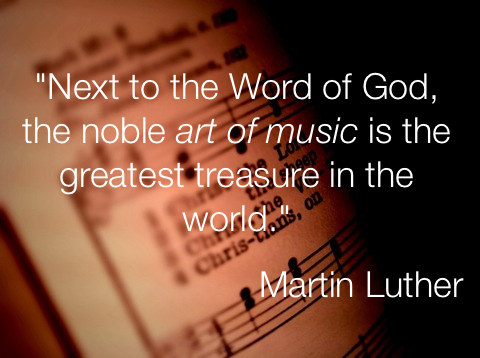
In summa, next to the Word of God, the noble art of music is the greatest treasure in the world. It controls our thoughts, minds, hearts, and spirits.... Our dear fathers and prophets did not desire without reason that music be always used in the churches. Hence, we have so many songs and psalms. This precious gift has been given to man alone that he might thereby remind himself that God has created man for the express purpose of praising and extolling God.

In proper Luther fashion, it is pointed out that the art of music serves the Word and not the other way around.  Don't screw that up.  We must be careful that we do not start worshipping music and forsake worshipping Christ.  Luther also seems to have no problem celebrating the emotions that are stirred by music.

organ.JPG

However, when man's natural musical ability is whetted and polished to the extent that it becomes an art, then do we note with great surprise the great and perfect wisdom of God in music, which is, after all, His product and His gift; we marvel when we hear music in which one voice sings a simple melody, while three, four, or five other voices play and trip lustily around the voice that sings its simple melody and adorn this simple melody wonderfully with artistic musical effects, thus reminding us of a heavenly dance, where all meet in a spirit of friendliness, caress and embrace. A person who gives this some thought and yet does not regard music as a marvelous creation of God, must be a clodhopper indeed and does not deserve to be called a human being; he should be permitted to hear nothing but the braying of asses and the grunting of hogs.

Luther's view of music in the Church was not a sentiment that was shared by all of the reformers.  He celebrated the organ, while some opposed it.  He celebrated using "artistic musical effects" while others felt it needed to be simplified.  He wrote music, while some felt only songs found directly in scripture could be sung.  Luther, because of his theology, didn't see music as something bad to be avoided but as a part of the creation redeemed by Christ.  And because of this view of creation, Luther celebrated the importance of music of all styles and it's relation to the Word of God.

The quotes from this post all come from the Forward to Georg Rhau's Symphoniae which was written by Martin Luther in 1538.  Photos taken by Corey Grunewald.

2 Comments

Comment

Do Denominations Still Have Value?

In the current ministry environment, I'd be willing to argue that the concept of denominations is not only under-valued by the majority of Christians and churches, but there it is also something that many places view negatively.  I'd like to challenge that idea because I believe that there is incredible value to denominations. I don't think denominations are without their flaws; in fact the fighting that happens within denominations is often the most brutal, unchristian behavior around.  But even with the flaws, denominations are filled with a rich history of practices that have proven valuable for the leaders and members of them.  Many of these things that I see as being valuable in denominations aren't unique to only churches that have "Lutheran" or "Baptist" or something of that sort in the name.  But I do believe that denominations have done many of these notably well.

385332820_1af00b22cb.jpg


Denominations Have a Built in Network of Churches

Imagine you have someone from your church moving to a new state for a new job.  Hopefully after being a part of your congregation, they have a desire to also be connected to a new home church as they make their move.  And finding a new church can be difficult - will be people be speaking in tongues? what do they believe about communion?  do they care when I was baptized?

The beauty of denominations is that it provides a great network of churches that fall in line when it comes to core theological beliefs.  Having a network of places that have the same view on the teachings of the Bible can be very beneficial when thinking about where to worship.  Now despite this network of churches that share beliefs, that doesn't guarantee that a church puts those beliefs into practice, that they have a good leader, or more simply that they are a healthy church.  Denominations don't eliminate these issues, but they absolute help.

What's interesting is many churches have taken this concept and have even expanded it beyond having the same beliefs; there are many organizations that have partner/network churches that share beliefs, vision, and strategy.  It's in a sense a modern take on the traditional approach to what denominations have long done.


Denominations Don't Hide Their Theological Leanings

One of my pet-peeves is when churches hide their theological leanings.

I really value when a church is clear about what they believe.  When I listen to messages by Mark Driscoll or Matt Chandler, I greatly respect when leaders are unapologetic about how they interpret the scriptures.  I don't necessarily agree with what they may teach about subjects like baptism, but I can appreciate that they are very clear about what they believe and why they believe it.  I think denominations do this well.  In the Lutheran world, I think our denomination (LCMS) specifically does a great job of saying clearly what we believe about the Bible.

Now on the other hand, we also have to be careful to not be like the Pharisees who seem to always have it all figured out and get caught up in legalism and miss out on following Jesus.  There is always a danger that we are only concerned with orthodoxy and have no concern of orthopraxy.  But to truly have an understanding of the scriptures, we can't have one without the other.


Denominations Have Systems of Training In Place

It seems like everyone these days gets ordained or is a pastor.  Now absolutely we are all called to be pastors to each other as Christians.  The biblical command to go and make disciples is not unique to church-workers and the idea of a full-time pastor isn't exactly found in the Acts 2 church.  But regardless of what the role of pastor looks like in a given day and age, the Bible always sets high standards for Pastors/Elders in churches.

The beauty of denominations is that they have built systems that hold their pastors accountable; they expect certain things to be learned and to be taught.  It is very dangerous when anybody can throw together a band and a motivational message and start a church.  This doesn't mean that this can't happen in contexts where there is no denominational structure; there are a lot of healthy churches that have set up systems of accountability for leaders.


Denominations Have an Ability to Support Church Planters

One of the things I've recently heard about our denomination is the desire to support church planters.  Church planting is an incredibly important job today, but it's extremely difficult.  Imagine going out with no money, no building, no people, and trying to make something happen.  And then couple that with the need to provide for your family, have a vision for what the church should look like, and work a full-time job to provide for your family.

In a denominational context, denominations have money to support church planters.  A pastor can decide to plant a church and give his full time and attention to the reality of making it successful because his denomination is able to help financially.  When denominations support church planters, the reality of being able to start new churches all over the world becomes just a little bit easier.

Photo Credit: Mindgraph

 

Comment